
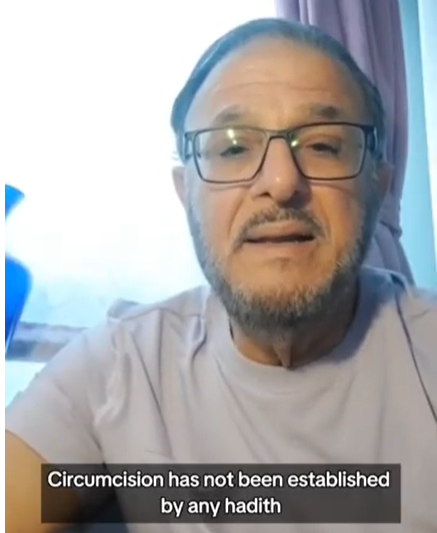
Egyptian pediatric surgeon, professor and scholar, Mohamed A. Baky Fahmy MD of Al-Azhar University, has released a new video discussing the facts about Islamic circumcision. The video is in Arabic with English captions.
Below is an English-language synopsis of what Dr. Fahmy discusses in the video.
From my position as a professor of pediatric surgery in Al-Azhar university which is one of the oldest continually operating academic institutions in the world and the chief center of Sunni Islamic scholarship. It holds immense religious, intellectual, and political significance throughout the Muslim world. I’m practicing pediatric surgery and dealing with all forms of penile surgeries and a wide spectrum of complications of circumcision along the last 42 years; I think I’m competent and professionally qualified to talk about this debatable topic of “Male Circumcision and its religious background in Islam.
There are a huge misleading and misunderstanding about male circumcision (MC) among Muslims all over the world. I will explain some crucial facts in this presentation.
To argue with Muslims about the legitimacy of MC should not refer to the sexuality or the differences between circumcised and intact men; as the main concern of the populations in Muslim societies is the holy act and God’s obedience when they are deciding to perform mutilation for their children.
I spent more than 10 years investigating the holy Quran, the Sunnah (Prophet Mohammed’s words) and consulting academic religious resources to discover honestly if there is any commandment or recommendation to circumcise any boy or girl.
Before starting I wish to elucidate the nature of orders in the Quran and in Sunnah; these are some important indisputable facts:
- Orders in the Quran are usually described in precise detail
- The order usually comes in the form of:
-
- acts that “you must do” or “you must not do”
- or a clear declaration that an act is desirable
- or, on the other hand, that a certain act is prohibited or forbidden
Unwanted behaviors or attitudes are indicated as sins; either major or minor. For example, the simple daily activity of going to toilet is strictly regulated; it is mentioned in the Quran how to clean yourself afterwards and even what do if you don’t have water to clean yourself. Another example (for females) is what to do during menstruation (the Quran demands avoidance of intercourse or prayer during this periodic event).
With this understanding, no one can authoritatively claim that circumcision is an Islamic holy act because it lacks any specific commandment or even any mention of it in the entire Quran.
Islamic scholars usually rely on one Quranic verse that prophet Mohammed and all Muslims should follow the life of Ibrahim, who Jews and Christians call Abraham.
In the Quran there are 114 chapters containing 77,000 words, with 63 direct mentions of Ibrahim. There is even a Quranic chapter dedicated to and named for Ibrahim. The Quran clearly states that Ibrahim was appointed as a prophet early in his adolescence and all details of Ibrahim’s life were documented.
So why there is no mention of Ibrahim’s circumcision in the Quran, the primary source for Islamic laws and regulations?
The secondary source for Islamic laws and regulation is the Hadith, a supplemental resource that documents the Prophet’s speeches, conversations, acts and behaviors. Muslims are asked to follow Prophet Mohamed’s orders and commands and are asked to emulate his behavior in life. Yet, the Hadith contains no clear order from the Prophet about the so-called “obligation” of circumcision, either for males or females. There is no clear order to “perform circumcision” or that “circumcision is necessary”
The only confident words about circumcision in the Hadith are these words from the Prophet:
“قول النبي ﷺ: الفطرة خمس، أو خمس من الفطرة: الختان، والاستحداد، وقص الشارب، وتقلم الظفر، ونتف الإبط
“There are five acts fitrah…” (i.e., human instincts, or natural disposition) “…circumcision, shaving the pubic hair, trimming the mustache, cutting the nails, and plucking the armpit hair.”
I believe that the Prophet considers those acts to be deeply seated in human nature, yet there is no commandment to do or not to do them.
Why do jurists insist upon and embrace circumcision without any similar command to shave pubic hair or trim mustaches?
Why did only circumcision become an “essential” holy act? Many scholars believe the reason lies in the fact that this form of genital cutting was imported into Muslim practices by Jews who later converted to Islam.
Another crucial point in this discussion is the behavior of the Prophet himself. It is well-documented that Prophet Mohamed had four girls and three sons; two sons died early in life, and one died at the age of 2 years.
The most important son of the Prophet is the last one who was born in the eighth year of Hijra. He was named Ibrahim and he lived for a year and a half. This son was highly valued and beloved by the Prophet and all the details of his life were documented and clearly mentioned in the Islamic books, even to the point of mentioning how he was breastfed and who his wet nurse was.
I spent a great deal of time and effort poring over many resources to locate any mention of circumcision of the Prophet’s male children (Ibrahim or the other two sons). If the Prophet had had his sons circumcised, surely this would have been celebrated and well-documented in precise detail somewhere in the life of the Prophet.
There is absolutely no mention about the Prophet Mohamed’s sons, daughters or (two) grandsons having been circumcised!
My research proves without any doubt that circumcision of males and females is not a tradition that is native to Islam, nor is male circumcision a covenant or a sacred bond to God for Muslims.


Comments are closed