
On September 14, 2026 a hearing was held in Multnomah County Court (Portland, OR) to decide on the State’s motion for Summary Judgment in Hadachek v. Oregon, the historic equal protection challenge to the state’s anti-female genital mutilation law. After hearing two hours of arguments, the court, overseen by Judge Melvin Oden-Orr, made no immediate decision. Over the coming weeks, the court will continue to review the evidence in order to decide whether the Hadachek case will proceed to a trial.
Hadachek v. Oregon was filed in March 2025, asserting that the current statutes (ORS 163.207 and 431A.600) that protect only female children from medically unnecessary genital cutting violate the equal protection guarantees of Oregon’s state constitution by failing to protect male and intersex children, causing both physical and stigmatic harm to these individuals. The case had survived an earlier attempt by the State of Oregon motion to dismiss the case, with the court ruling on October 23, 2025 that the case had legal merit and the plaintiffs had standing, marking the first time a U.S. state court had allowed a challenge to proceed on these grounds.

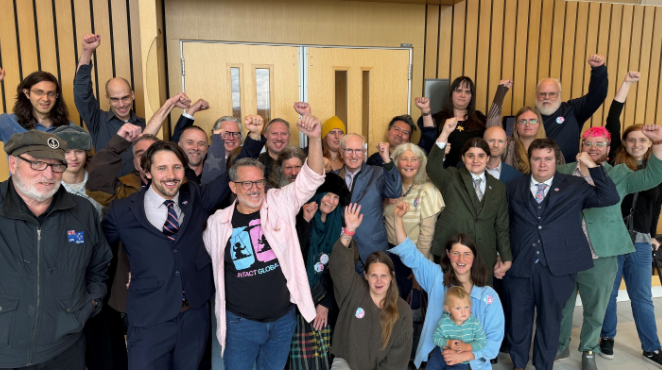
Inside the courtroom before the Hadachek v. Oregon hearing.
The case, brought by attorney Eric Clopper with the assistance of Portland gay civil rights attorney Lake Perriguey and Intact Global former law clerk Samer Saffarini, attracted numerous amicus briefs (Latin: “friend of the court” briefs), which the court had reviewed in advance of the September 14 hearing.
GALDEF tapped into its “litigation war chest” to help pay an attorney to officially file a brief on our behalf in support of the plaintiffs. The brief was joined by the 15 Square organization (U.K.) and the Swiss group Prepuce.ch. The full GALDEF brief can be viewed here.
In GALDEF’s brief, Executive Director Tim Hammond stated that male circumcision causes long-term physical, sexual, and emotional harms to boys and men, citing numerous published studies. He asserted that non-consensual genital cutting violates children’s rights to bodily integrity and autonomy, regardless of sex, and that numerous international medical and human rights standards favor Plaintiffs.
Other briefs were submitted by Doctors Opposing Circumcision, Attorneys for the Rights of the Child, Intact America and Intaction, pediatrician Robert S. Van Howe, researcher Christopher J. Cold, and physician Mathias Mesam, as well as Portland’s Genital Autonomy Collective for intersex, trans and gender diverse people affected by newborn/childhood penile circumcision.
Submitting a single brief in support of the State of Oregon were Equality Now, the U.S. End FGM Network and Sahiyo. In their brief, the organizations falsely claimed that “FGM is distinct from male circumcision”; to the contrary, numerous briefs from GALDEF and others showed clear overlap and common ground between these harmful practices. The organizations also argued FGM is a unique form of “gender-based violence” and “discrimination” against a “particularly vulnerable class.” GALDEF countered by quoting U.S. District Court Judge Bernard Friedman – in his 2018 rejection of the “gender-based violence” argument in United States v. Nagarwala – when he concluded, “As laudable as the prohibition of a particular type of abuse of girls may be, it does not logically further the goal of protecting children on a nondiscriminatory basis.”
Hammond, who could not attend the hearing due to temporary travel restrictions after a medical procedure, observed “Since virtually every society where FGM is practiced also practices MGM, the only societies that could be credibly accused of permitting gender-based violence in the context of genital cutting are those that prohibit FGM but permit MGM (e.g., the United States).”
Hammond also provided the following commentary:
1. The State stressed that FGM and MGM can’t be compared because males do not have labia or a clitoris, the excision of which is prohibited under anti-FGM statutes. It conveniently ignores that females and males both have a prepuce (clitoral foreskin/penile foreskin), in which excision of the former is prohibited but excision of the latter is not.
2. The State’s argument rests on an assumption that the purpose of the anti-FGM statute is to prevent harm. Medicalization would offer risk reduction to make FGM less drastic and safer, but anti-FGM advocates oppose medicalization, knowing that it would institutionalize and legitimize the practice, making it harder to eradicate, similar to the obstacles facing MGM eradication. However, if all forms of FGM were truly harmful, such statutes would prohibit even adult women from choosing it, but they do not. The core issues inherent to anti-FGM laws are preserving bodily integrity, autonomy, consent and choice; issues that are equally important to those born male or intersex.
3. The State voiced objections to discussions of intersex children in the Hadachek case because it presumably views the case through a binary lens (i.e., male versus female). It ignores the larger issues raised by Hadachek, those of bodily integrity, autonomy, consent and choice. While some intersex children can be born with atypical hormonal/chromosomal differences or gender-atypical internal reproductive organs, some can still present with male typical genitals, putting them at risk of penile circumcision, making intersex discussions extremely relevant to the Hadachek case. The State also ignores that intersex newborns and children with atypical/non-binary genitals are often subjected to other medically unnecessary gender-normalizing genital surgeries that violate the bodily integrity, autonomy, consent and choice that form the core issues behind anti-FGM statutes.

Comments are closed