

By: T. T. Perry, Ph.D.
T.T. Perry, PhD (“Perry”) is a Portland, Oregon sensory scientist, board member and Science Communicator for the Genital Autonomy Collective, as well as a member of the Genital Autonomy Legal Defense and Education Fund’s advisory council. Perry and advisory council member Alliana Arshad attended the historic September 14 hearing and submitted a first-person account of this latest event in the fight for children’s rights and sex equality.
The Hadachek v. Oregon hearing took place on Monday, September 14, at 9:30 AM. The line to get through security screening at the Multnomah County Courthouse was so long that it stretched out the door and turned back down the block. I found myself queuing behind someone familiar wearing an Intact Global t-shirt. We had last met at the Intact Global Conference in April in Los Angeles. While waiting to get through the building doors, we caught up with each other and discussed the upcoming hearing.
The State of Oregon had filed a motion for summary judgment, asking the judge to dismiss the case due to a variety of alleged legal insufficiencies surrounding standing, constitutionality, and potential remedies. The plaintiffs asked the Court to deny the State’s Motion for Summary Judgment. This morning’s hearing would be all about the issues raised in the Motion for Summary Judgment as well as issues raised by the various people and organizations who filed amicus briefs with the Court.
Once inside the courthouse someone approached me and asked if I knew of any resources for circumcision sufferers who are interested in suing the hospital and healthcare professionals who cut their genitals. I suggested they look up GALDEF to find resources about circumcision-related lawsuits.
Within minutes, the hallway outside Courtroom 9C filled with people making introductions, sharing pronouns and phone numbers, handing out buttons and pins with the Intact Global logo, and even exchanging BBQ invitations. Once we were allowed within the courtroom itself, I sat in the gallery next to Alliana Arshad, founder of the Genital Autonomy Collective and fellow GALDEF advisory council member. A videographer was setting up to record audio and video of the hearing. More people entered, pulling chairs into the courtroom to accommodate everyone. I was impressed with the LGBTQIA representation in the gallery. One of the plaintiffs was here, seated with his counsel. As the clock hands swept past 9:30 AM, we waited quietly, nervously, excitedly for the hearing to begin.
We all stood when the judge entered the courtroom. I tried to relish the final, brief chance to stretch my legs before the hours of sitting on that wooden pew. Judge Oden-Orr asked us to be seated, and the hearing got started with some discussion of additional filings. The first was a filing from the State in which it claimed it had retained an unnamed expert who would create a genuine dispute of fact regarding the biological differences that would justify the statute. The plaintiffs pointed out that this filing was improper (because the moving party cannot add additional evidence after filing the motion for summary judgment) according to procedural rules and that this was the first time the State was claiming to show a biological difference between the male and female prepuce. The judge recognized that the filing was improper and struck from the record the State’s late filing about an unnamed expert who would testify about biological differences.
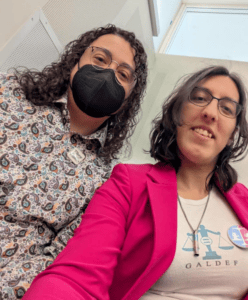
T.T. Perry and Alliana Arshad
From there, the hearing moved through the elements of the State’s motion, with two attorneys for the State handling different issue areas of the motion. First, the State disputed whether the plaintiffs had standing. There was some discussion of whether a plaintiff (Hellewell) who didn’t currently live in Oregon had standing, and some discussion of whether to accept additional filings from the plaintiffs about standing. I think the answer was not to accept these filings from the plaintiffs, but the contents of the additional filings sounded fairly inconsequential when read aloud.
Next, the State argued that the anti-FGM laws are constitutional because they are based on biological differences that are rationally related to the purpose of the statute. What are those biological differences? The State never elaborated on any biological differences except to say that female genital mutilation can only happen to females because males don’t have any labia or clitoris. It seems to be both a circular argument and a non-biological argument that ignores that there are intersex people who were assigned male at birth yet still subjected to the very acts that are defined in law as female genital mutilation. I raised this issue in the amicus brief I filed on behalf of The Genital Autonomy Collective, and this brief got mentioned. I hope the attorneys for the State read the brief carefully because it helps make clear that whether or not a phallus is a clitoris or a penis is less a biological fact and more a subjective judgment made by adults.
Another argument made by the State was that protection from nonconsensual genital cutting was a female privilege (not a right) and it was acceptable for the State to grant privileges to some people based on sex. At some point the judge seemed confused as to whether the anti-FGM laws have a sex-based distinction in their implementation, but both the State and the plaintiff agreed that the laws do discriminate on the basis of sex. Where the State and the plaintiff disagree is whether or not that sex-based discrimination is justified by specific biological differences.
The third major issue raised by the State was that it believed the Court cannot grant the remedy requested by the plaintiffs to extend the anti-FGM statutes to protect all children regardless of sex traits. The State argued that this violates the separation of powers because it would require, the State claims, the Court to rewrite legislative statutes. At this point the gallery had been waiting inside or outside for almost three hours, and people were getting more restless, shifting their weight. Patience and attention were wearing thin, and I knew I wasn’t alone feeling confused about the verbal back-and-forth in the courtroom about prior cases and how they might or might not apply to the current case.
It was a tense, challenging, and emotional day about a highly personal and intimate topic: the right to have control over one’s own body, particularly the right to say no to unnecessary genital amputation. Is the right to one’s private parts a female-only, endosex-only privilege? Or does the Equal Rights Amendment require the State to protect all children regardless of their sex traits or gender? The judge concluded the hearing a little before noon without ruling from the bench, which suggests he is taking these questions of law and the issues raised in the filings very seriously and wants to tread carefully. There is no strict deadline by which we can expect a ruling. If the judge ultimately denies the State’s motion for summary judgment, then the next step in Hadachek v. Oregon is a trial in December to determine the facts about genital cutting. If the judge grants the State’s motion, then I expect the plaintiffs to appeal.
As we left the courtroom, we gave our thanks and congratulations to the plaintiffs’ attorney, Eric Clopper, for his careful rebuttals and his defense of equal rights for all children. A feeling of relief and collective joy spread among the crowd as we stretched our bodies. We took a group picture (minus those of us who desperately sprinted to the bathrooms) and went to lunch, where we would continue to discuss the morning’s events over burgers and fries in beautiful downtown Portland.


Comments are closed